
The science behind EyeQuant
For over a decade, EyeQuant has worked with a team of neuroscientists to understand how the brain decides what's important — and to turn that understanding into a model that predicts attention before a single human sees your design.
This page explains how it works.
How the eye reveals what the brain prioritizes
Human attention is limited, but the eye is generous with information. It sends more than 100 billion signals to the brain every second, and the patterns in how it moves — where it lands, where it lingers, what it skips — reveal what the brain has decided matters.
Researchers have studied these patterns for decades to understand subconscious behavior. Three movements do most of the work:
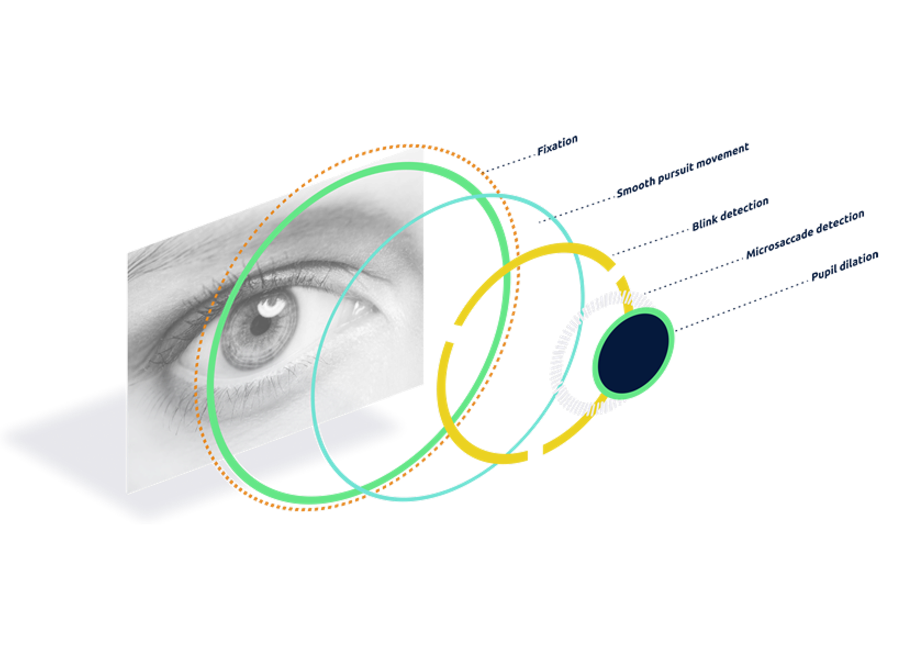
- Saccades — the rapid jumps the eye makes between points of interest
- Fixations — the brief moments of stillness where actual perception happens
- Smooth pursuit — the tracking motion the eye uses to follow movement
By measuring these in laboratory studies, we can quantify which visual features capture attention, in what order, and for how long. That tells us what the brain is unconsciously prioritizing when someone looks at a design.
How we turn that into a prediction
Inspired by the biology of human vision, we use artificial neural networks to predict how a person will perceive a design in the first three to five seconds — the window where most attention decisions are made.
Our models were trained on:
- 20,000 experiments with hundreds of participants
- 1.6 million data points of eye-tracking and attention data
- Visual features including luminance, edge density, color saturation, contrast, and structural composition
The result is a model that predicts where attention goes on any design, without needing to put it in front of a single user.
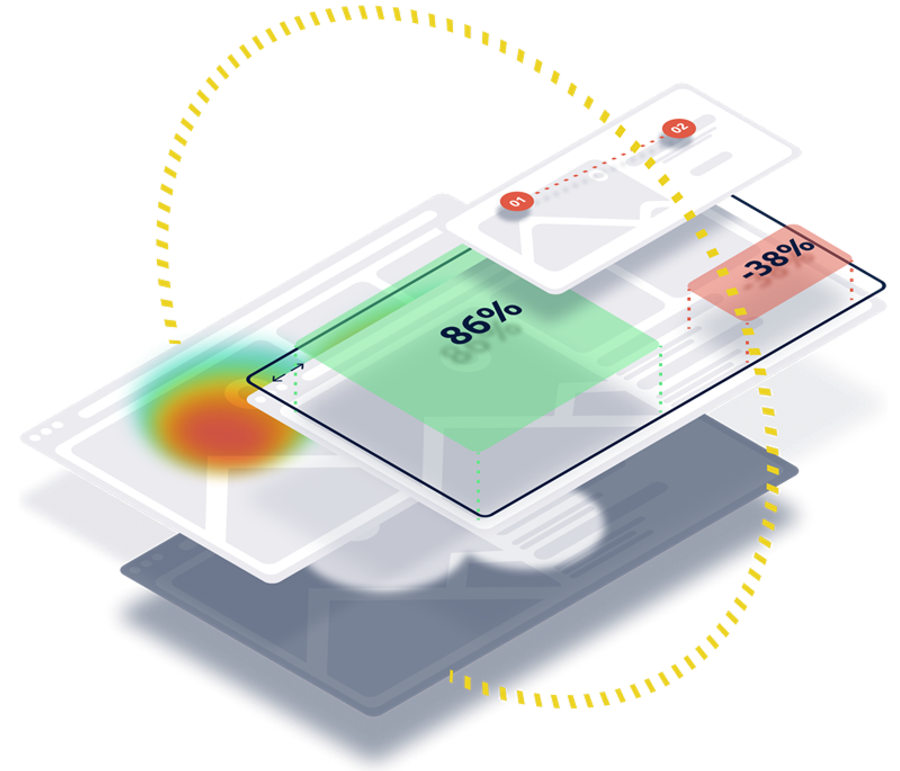
How accurate is it?
We validate every model update against empirical eye-tracking studies. EyeQuant's predictions are 90% as accurate as running a physical study with hundreds of participants — delivered in seconds instead of weeks, at a fraction of the cost.
That's the tradeoff: not perfect, but predictive enough to catch the issues that matter, fast enough to use on every design before you ship it.
Microsaccades and the resolution of attention
Even when the eye appears to be still during a fixation, it isn't. It makes tiny, involuntary movements called microsaccades — small jitters that keep the visual system active and prevent the image on the retina from fading.
These movements matter because they reveal something important: attention isn't binary. It's not just a question of where someone looks, but how engaged they are once they get there. Microsaccade patterns help distinguish between a glance and genuine focus — between a viewer who saw your headline and one who actually read it.
EyeQuant's models account for this distinction, which is why our predictions go beyond a simple heatmap of “where eyes land” and instead reflect the depth and quality of attention across a design.
Attention is shaped by intent
A person looking for a “Buy now” button doesn’t see a webpage the same way as someone casually browsing. The brain tunes attention based on what the viewer is trying to do — a phenomenon researchers call goal-directed attention or task-driven attention.
This is why a design that performs well in one context can fail in another. A homepage viewed by someone exploring your brand is a different attention problem than the same homepage viewed by someone ready to convert.
EyeQuant lets you predict attention for different intents, so you can answer questions like:
- What does a first-time visitor notice first?
- Does a returning customer find the path to checkout?
- Does the right call-to-action stand out for the user we actually care about?
By modeling intent alongside visual features, EyeQuant predicts not just what people will see, but what they’ll see given what they’re trying to do — which is what determines whether a design actually works.
From science to a single click
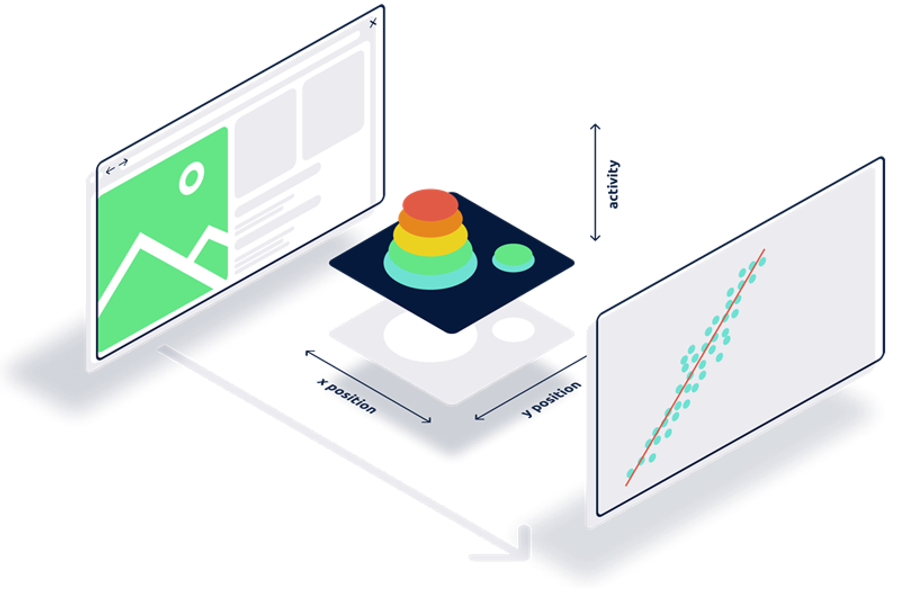
The technology is complex. Using it isn’t.
In one click, EyeQuant analyzes your design and returns reports on visual hierarchy, clarity, and emotional impact — the things that determine whether your design works or gets ignored. No participants, no scheduling, no waiting.
That’s how you make every design your first test.
Frequently asked questions
- What kinds of designs does EyeQuant work on?
- EyeQuant works on any static visual design — websites, landing pages, ads, product UI, packaging, emails, and more. If you can export it as an image, EyeQuant can analyze it.
- How does this compare to traditional user testing?
- EyeQuant doesn't replace user testing — it replaces the first round of it. Traditional eye-tracking studies take weeks, cost thousands of dollars, and require recruiting participants. EyeQuant gives you the same kind of attention data in seconds, so you can iterate dozens of times before involving real users. Most of our customers use EyeQuant to catch issues early and reserve user testing for higher-stakes validation later in the process.
- How accurate is EyeQuant compared to a real eye-tracking study?
- Our predictions are 90% as accurate as conducting physical studies with hundreds of participants, validated against ongoing empirical research.
- What can EyeQuant predict — and what can't it?
- EyeQuant predicts pre-attentive visual processing: where attention goes in the first three to five seconds, what gets noticed, what gets missed, and how clearly your visual hierarchy communicates. It does not predict downstream behavior like clicks, conversions, or comprehension of complex text — those depend on factors beyond visual attention.
- Do I need to know neuroscience to use it?
- No. The science is what makes the predictions accurate; the product is designed for designers, marketers, and product teams. In one click, you get a heatmap, an attention score, and clear recommendations on what to fix.
- How is EyeQuant different from other attention prediction tools?
- EyeQuant is the longest-running attention prediction platform on the market, trained on the largest dataset of validated eye-tracking studies in the industry. We also model intent — predicting attention based on what a viewer is trying to do, not just what's on the screen — which most other tools don't.
- Can I use EyeQuant on designs that aren't live yet?
- Yes — that's the entire point. EyeQuant is designed to be your first test, before you ship anything. You don't need traffic, users, or a published page. You only need the design.

See what your users will see.
Start with a free trial, no credit card, no tracking code, no setup. Upload your first design and get results in seconds.